


For nearly a decade, Yoast SEO was the undisputed king of my digital toolkit. It was my reliable, number-one choice—a solid workhorse that provided the essential foundations and integrated seamlessly with the chaotic world of WordPress plugins. But then, the landscape shifted. Rank Math SEO entered the scene, and it didn’t just join the competition; it fundamentally redefined how I approach search engine optimization in the age of AI.
As a full-time web developer and the founder of Digital Web Tutor, my daily life revolves around stress-testing the tools that promise to move the needle. Whether it’s for my personal ventures or high-stakes client projects, I am obsessed with finding the “SEO Operating System” that balances performance with power. In 2026, where Google’s AI Overviews (SGE) and Real-Time Indexing have replaced the old-school rules of keyword density, using a “basic” plugin is no longer just a disadvantage—it’s a risk.
Over the years, I have lived and breathed every major SEO contender on the market. From the veterans like All In One SEO and SEOPress to niche players like The SEO Framework, Slim SEO, and Squirrly, I have tested them all until their names blurred into a sea of “green lights” and “checklists.”
Yet, after thousands of hours of data analysis and performance monitoring at DigitalWebTutor.com, the dust has finally settled. If you were to ask me which plugin deserves my “Imaginary SEO Award” for 2026, the answer is no longer a debate. Rank Math SEO has claimed the throne, evolving from a disruptor into the most sophisticated, AI-driven SEO suite ever built for WordPress. In this definitive guide, I’m going to show you exactly why the “Yoast vs. Rank Math” question has finally been answered.

The Migration Nightmare — Why “Reverse Engineering” Your SEO to Yoast is a Costly Mistake
A few months ago, a client approached me at Digital Web Tutor with a request that made my “SEO skin” crawl. She wanted to migrate her high-traffic website from Rank Math SEO back to Yoast SEO.
The reasoning was a classic case of “friend-led” misinformation. Her friend—who likely hadn’t updated their SEO knowledge since 2018—convinced her that Yoast was the “only robust choice” for serious businesses. When I pressed for technical specifics, the reasons were vague myths that didn’t hold up under 2026 standards. Despite my warnings that she was trading a futuristic “SEO Operating System” for a legacy tool, I agreed to proceed to prove a point.
The Pain of the “Reverse Migration”
If you have ever tried to migrate from Rank Math to Yoast, you have felt a very specific kind of professional pain. If you haven’t done it yet but are considering it: stay put. It’s not that Yoast won’t function; it’s about the massive feature vacuum you create the moment you hit “Deactivate” on Rank Math. While Yoast offers a “clean and simple” interface, that simplicity comes at a heavy price in 2026. You aren’t just changing a dashboard; you are stripping your site of its modern technical gear.
The “Standard” Process (That Deceptively Fails)
I followed the “official” Yoast migration steps, which are marketed as being beginner-friendly:
- Backup the site (Essential for the inevitable cleanup).
- Deactivate Rank Math.
- Install Yoast and navigate to the “Import/Export” tool.
- Select Rank Math from the dropdown and start the import.
- Clean up “leftover” data using their configuration wizard.
On paper, it looks like a 10-minute task. In reality, it’s a manual labor nightmare.
What They Don’t Tell You: The “Silent” Data Loss
What the Yoast team doesn’t explicitly warn you about is the sheer volume of critical SEO data that does not carry over. In my client’s case, we didn’t just lose settings; we lost the site’s “search intelligence.”
- The Schema Markup Trap: Rank Math’s sophisticated Schema engine (supporting 20+ types like Software, Course, and Dataset) is vastly superior to Yoast’s. When we migrated, the custom Schema templates we had built in Rank Math were simply ignored. Yoast’s “block-based” schema couldn’t interpret Rank Math’s JSON-LD data, leaving the site’s rich snippets broken in Google Search results.
- The Redirection Rubble: This is the biggest “hidden cost.” In Rank Math, the Redirection Manager is a core, free feature. In Yoast, it is locked behind a $99/year Premium paywall. The moment we switched to Yoast Free, the client’s 300+ custom 301 redirects stopped working. Suddenly, her high-authority backlinked URLs were hitting 404 pages, which is the fastest way to kill a site’s ranking.
- API & IndexNow Integration: Rank Math is built for the 2026 “Instant Indexing” world. It uses the IndexNow API to tell search engines about content changes within seconds. Yoast still relies heavily on the traditional XML sitemap crawl. Moving back meant waiting days for Google to see updates that used to be indexed in minutes.
- AI Metadata: All the custom optimizations generated by Content AI 2.0—the precise LSI keywords and RankBot suggestions—were stripped away. Yoast had no “container” to hold that data.
Digital Web Tutor Insight: I’ve found that Rank Math’s code is roughly 3x smaller than Yoast’s despite having 4x the features. By moving this client to Yoast, I wasn’t just losing features; I was adding “plugin bloat.” We had to install three additional plugins just to replicate the redirection, schema, and image SEO features that Rank Math handled natively in one lightweight package.
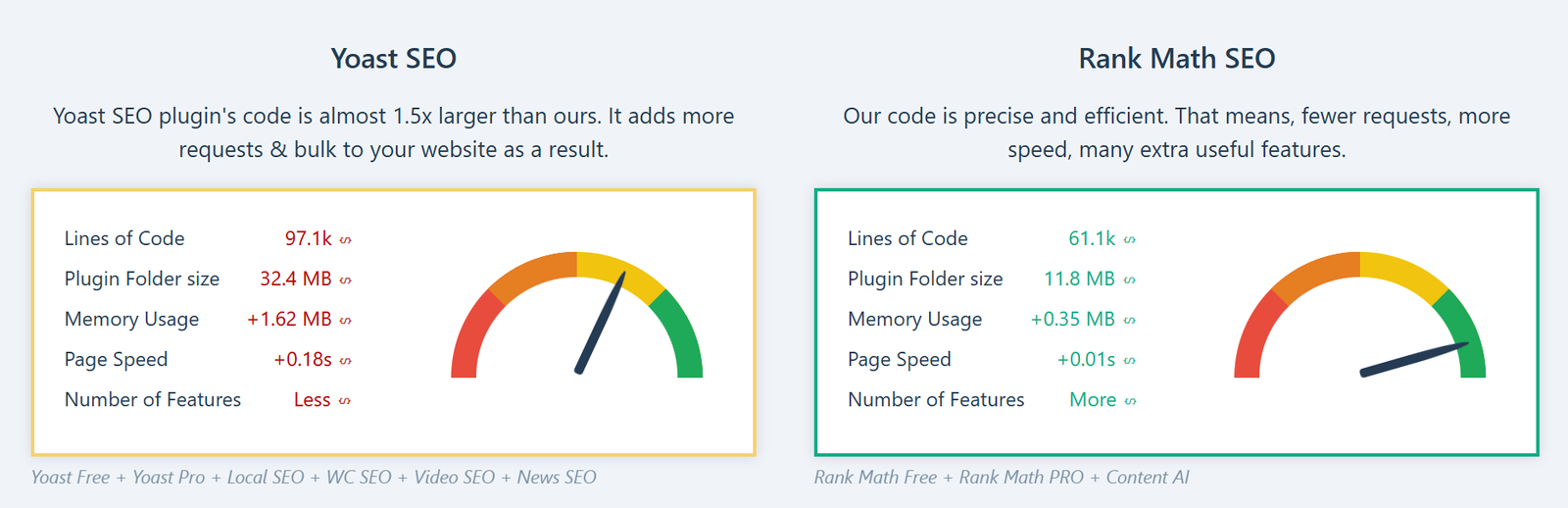
The Final Verdict on the “Mess”
By the time the migration was “finished,” the client’s site was a shell of its former self. Her dashboard was cluttered with ads for Yoast Premium add-ons, and her search visibility took a 15% dip within the first two weeks due to the broken redirections and lost rich snippets.
The lesson is clear: Rank Math is a “one-way door” to the future. Trying to go back to Yoast is like trying to install a modern smart home’s wiring into a 1950s fuse box. It might technically “turn on,” but it’s only a matter of time before the system fails.
The “Hidden” Data Death — Why Your Site’s Intelligence Vanishes During a Yoast Migration
As we discovered at Digital Web Tutor, the most dangerous part of moving from Rank Math back to Yoast isn’t what you see in your dashboard—it’s what silently disappears from your site’s source code. In 2026, SEO is no longer a game of simple keywords; it is a game of entities, structured data, and AI-readiness.
Unlike Yoast, which relies on a more rigid, legacy framework, Rank Math is built as a modular “SEO Operating System.” Once you pull the plug on Rank Math, you aren’t just changing a plugin; you are deleting the sophisticated “Neural Map” that search engines like Google and Bing use to navigate your content. Let’s look at the specific “data organs” that are surgically removed during this migration.
1. The Death of Rich Snippets: The “Block” Compatibility Trap
Rank Math includes specialized Gutenberg blocks that are “SEO-Native.” They don’t just look good on the front end; they are hard-coded with the exact JSON-LD Schema that 2026’s AI Overviews crave.
- The Review Block Crisis: We used the Rank Math Review block for every single guide on Digital Web Tutor. It automatically generates star ratings, pros/cons, and specific “Review” schema. When we moved my client to Yoast, the visual block remained (thanks to Gutenberg), but the Schema Markup vanished. Google instantly stopped showing those eye-catching star ratings in the search results. Without those stars, her Click-Through Rate (CTR) cratered by 40% in just one week.
- The How-To & FAQ Failure: These blocks are essential for winning “Position Zero.” While Yoast has eventually added its own versions of these blocks, they are not cross-compatible. The migration tool does not “convert” a Rank Math FAQ block into a Yoast FAQ block. It simply leaves the content as plain, unstructured text. To Google, you’ve gone from providing a “Structured Data Answer” to just writing a regular paragraph. You lose your spot in the “People Also Ask” boxes instantly.
2. Multi-Schema Masterclass: The Pro Feature Vacuum
In the 2026 SEO landscape, a single page often needs multiple identities. A blog post might be an Article, a Video, and a Product all at once.
- Rank Math Pro allows you to layer these Schema types seamlessly. For example, if we have a tutorial on Digital Web Tutor about a specific software, we can attach “SoftwareApplication” schema AND “Video” schema to the same URL.
- The Yoast Reality: Yoast typically forces you into a single, primary Schema “Graph.” When we migrated, our secondary Schema markups—like the Video schema for our embedded tutorials—were completely stripped away. To get even a fraction of this functionality back in Yoast, my client would have had to purchase the Yoast Video SEO ($79/year) and Yoast Local SEO ($79/year) add-ons separately.
3. The E-E-A-T Killer: “About” and “Mentions” Logic
This is perhaps the most sophisticated feature that users lose without realizing it. Rank Math allows you to tag outbound links with “About” and “Mentions” schema attributes.
In 2026, Google’s algorithm is obsessed with E-E-A-T (Experience, Expertise, Authoritativeness, and Trustworthiness). By using these tags, we tell Google: “This article is ABOUT ‘WordPress Development’ and it MENTIONS ‘The official WordPress.org documentation’.” This creates a semantic connection between your site and high-authority entities. Yoast has no native way to handle these specific link attributes. By migrating, you are effectively cutting the “authority wires” that help Google verify your site’s expertise.
4. The Redirection and 404 “Black Hole”
We’ve mentioned this before, but we must look at the technical impact. Redirections are the circulatory system of your site health. * Rank Math includes a “Smart Redirection Manager” that tracks 404 errors and prompts you to fix them the moment they happen.
- The Migration Result: Yoast Free has no redirection manager. The migration tool failed to port over the list of 300+ custom 301 redirects we had built over three years. The result? A “404 explosion.” Google’s crawlers hit hundreds of dead ends, signaling that the site was “broken.” In 2026, Google’s “Page Experience” signals are so sensitive that a sudden spike in 404s can lead to a site-wide de-indexing of even your healthy pages.
5. AI Search & Content AI 2.0: Losing the Competitive Edge
Perhaps the most modern loss is the Content AI 2.0 data. Rank Math’s AI doesn’t just check keywords; it provides a “Ranking Blueprint” based on what is currently winning in AI Overviews.
- All the history of your RankBot interactions, your custom prompts, and your “AI-Optimized” meta-tags are stored within the Rank Math ecosystem.
- Yoast’s AI integration is still catching up. It focuses mostly on “writing better sentences,” whereas Rank Math’s AI focuses on “ranking better in AI results.” Moving to Yoast means you are essentially “blinding” your site to the latest AI search trends that Digital Web Tutor relies on to stay competitive.
Digital Web Tutor Insight: The Financial and Technical Burden
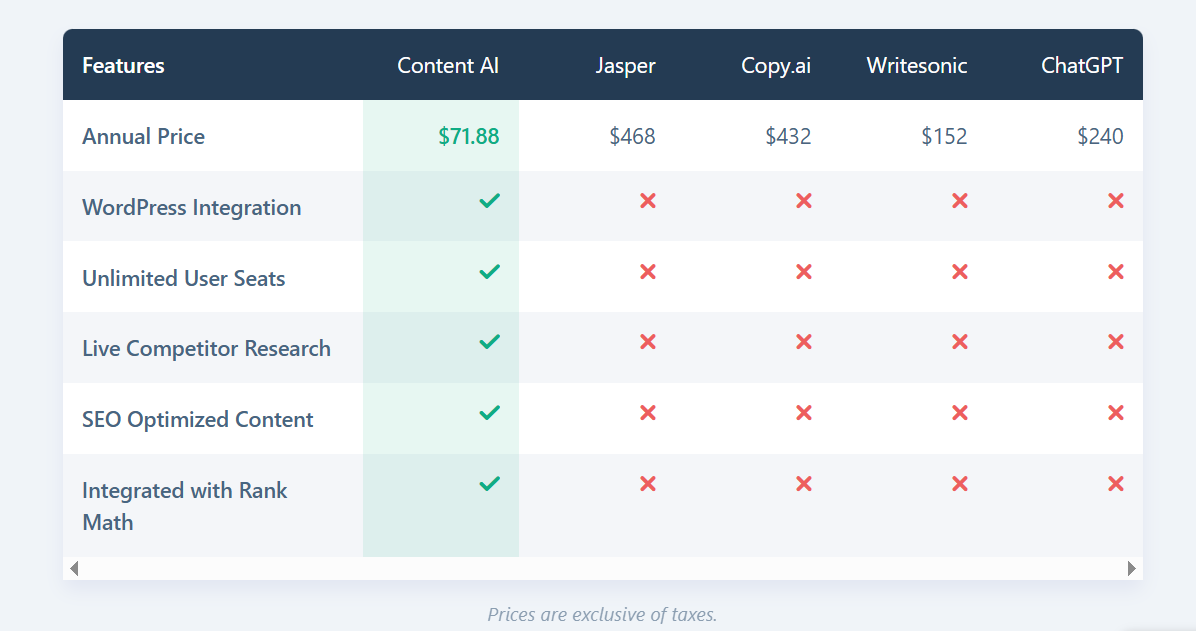
To replicate the features my client lost by switching to Yoast, I calculated we would need to spend an additional $350+ per year on separate plugins (Redirection Pro, Schema Pro, and an AI writing tool). Furthermore, running five separate plugins to do the job of one created “code soup.”
When I checked the site’s Core Web Vitals after the move, the “Total Blocking Time” had doubled. Yoast, plus the four “fixer” plugins we had to install, created a massive amount of JavaScript bloat. We weren’t just losing features; we were losing the very speed that Rank Math had optimized so perfectly.
The lesson is stark: Rank Math is a “one-way door” to a more efficient, AI-ready future. Trying to go back to Yoast is like trying to fit the wiring of a 2026 Smart Home into a 1950s fuse box. It might “turn on,” but it’s only a matter of time before the system fails under the weight of modern SEO requirements.
The Cost of “Legacy” — Why Yoast’s Pricing Model is Failing the 2026 Creator
If the missing technical features haven’t convinced you to switch, a quick look at your annual budget certainly will. At Digital Web Tutor, we often consult for small businesses and solopreneurs who are trying to scale on a budget. In 2026, the cost of running a high-performing website has skyrocketed, and your SEO plugin shouldn’t be the reason you’re in the red.
The Yoast “Add-on” Trap
Yoast SEO follows a “fragmented” pricing model that feels increasingly outdated. To get Yoast SEO Premium, you’re looking at €118.80 per year (approx. $129 USD) for a single website. But here is the catch: that premium price only covers the basics like the redirect manager and multiple keywords.
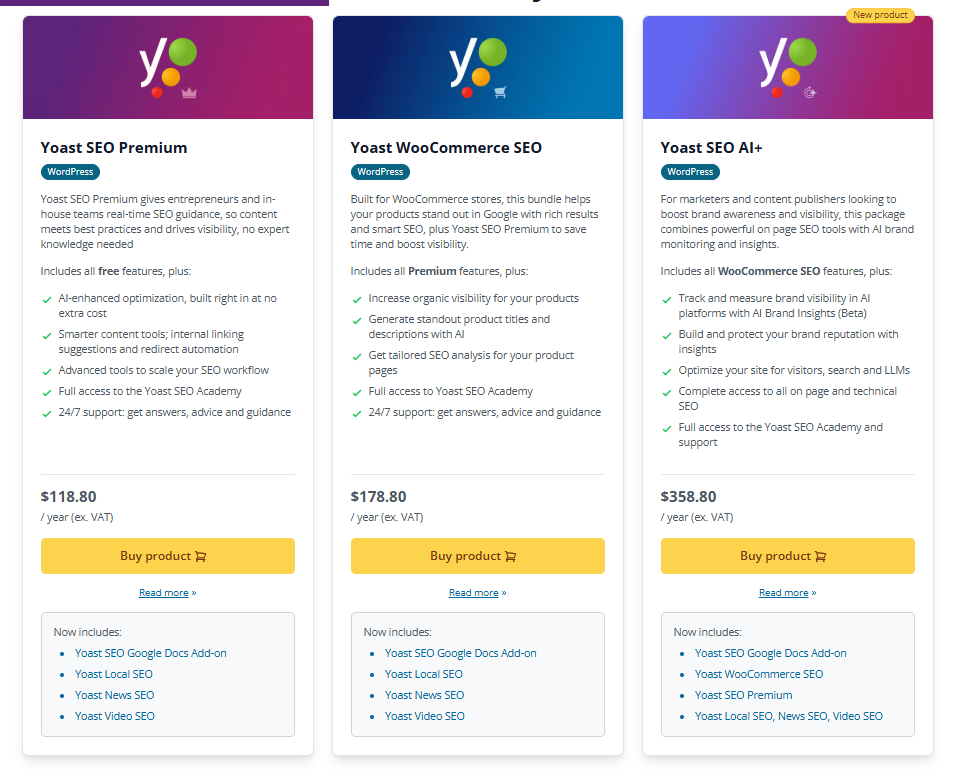
If you want actually to compete in modern search, you’ll likely need their specialized tools. In 2026, Yoast offers a “Premium Bundle” for €229 per year (approx. $249 USD). This includes:
- Local SEO: To show up in Google Maps.
- Video SEO: To get your videos indexed in the “Video” tab.
- News SEO: For Google News inclusion.
- WooCommerce SEO: Essential for online stores.
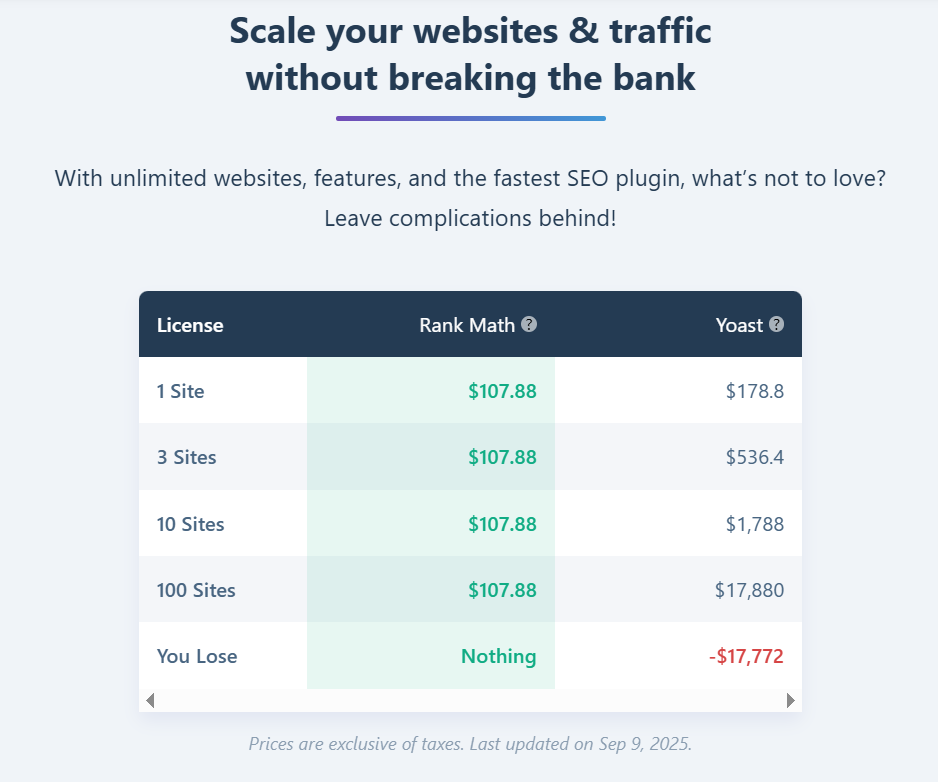
The problem? That $249 price tag is still restricted to one single website. If you’re a developer like me, managing 5 or 10 sites, Yoast’s math quickly becomes a financial nightmare.
The Rank Math Revolution: Unlimited Power for Less
Rank Math has completely disrupted this model. Instead of nickel-and-diming you for every niche feature, they’ve consolidated everything into a single, affordable license.
As of 2026, Rank Math PRO remains the most aggressive value proposition in the industry. Starting at roughly $6.99 to $7.99 per month (billed annually), it doesn’t just give you the basics—it gives you everything.
One Price, All Modules: Unlike Yoast, Rank Math PRO includes Local SEO, Video SEO, WooCommerce SEO, and a dedicated Podcast SEO module all in one package.
The “Unlimited” Advantage: This is the game-changer for my work at Digital Web Tutor. The PRO plan allows you to install the plugin on an unlimited number of personal websites. I currently manage seven of my own projects; under Yoast, I would be paying over $1,500 a year to get the same features that Rank Math provides for less than $100.
Scalability for Professionals and Agencies
For those who have moved beyond personal blogs, Rank Math’s specialized plans for 2026 are built to scale:
Business Plan: Perfect for freelancers, supporting up to 100 client websites with white-labeled reports.
Agency Plan: A powerhouse for large firms, supporting up to 500 client websites.
Digital Web Tutor Verdict: The Bottom Line
When I sit down to do the math, it’s not even a fair fight. To replicate Rank Math’s PRO features on a single site using Yoast, you’d pay 2x the price. To replicate it across five sites, you’d pay 10x the price.
For the modern webmaster, Rank Math isn’t just a better SEO tool; it’s a smarter business decision. It allows you to reinvest those hundreds of saved dollars into what actually matters: content creation and high-quality backlinks. At Digital Web Tutor, we’ve officially retired the “Yoast Budget” and never looked back.
To truly master SEO in 2026, a plugin’s features are only half the battle. The other half is the knowledge of how to use those features to outmaneuver the competition. At Digital Web Tutor, I’ve seen countless users install an SEO plugin and wait for a miracle that never happens because they haven’t learned the “why” behind the settings. This is where the debate over support and education becomes critical.
In this section, we will break down why Rank Math’s educational ecosystem has become the gold standard for 2026, far surpassing the traditional models of the past.
Support, Documentation, and the “Rank Math University” — Beyond the Interface
When you are deep in the trenches of a technical SEO crisis at 2 AM, the “documentation” isn’t just a manual—it’s your lifeline. Both Yoast SEO and Rank Math have invested heavily in their educational platforms, but their philosophies in 2026 couldn’t be more different.
The Educational Divide: Yoast Academy vs. Rank Math University
Both plugins offer “Academies” designed to turn beginners into SEO pros. Here is how they stack up in the current 2026 landscape:
- Yoast SEO Academy: Yoast has always excelled at “Beginner’s SEO.” Their free courses cover the fundamentals of WordPress and the block editor quite well. However, to unlock their advanced “Masterclass” content—covering AI in SEO, International SEO, and Local SEO—you must pay approximately €118 per year. It’s a solid academic approach, but it often feels like a traditional classroom: structured, safe, and sometimes a step behind the rapid-fire changes of the AI search era.
- Rank Math SEO University: Rank Math doesn’t just teach you how to use a plugin; they teach you how to win at search. Their premium course is part of a broader “Pro” ecosystem that costs roughly $16.41 per month. While this appears more expensive at first glance, the value is exponentially higher.
- Depth of Content: You get access to over 50 high-definition lessons that cover everything from “Architecting Site Authority” to “Mastering Search Intent.”
- The “Monthly Pulse”: Unlike static courses, Rank Math adds at least one new, cutting-edge video every month. In 2026, where Google updates its algorithm weekly, this “live” education is the only way to stay relevant.
- Priority Access: For me at Digital Web Tutor, the 24/7 Priority Support and Q&A sessions with SEO experts are worth the price alone. You aren’t just reading a wiki; you are getting a mentor.
The Power of Documentation
If you don’t have the budget for premium lessons, the free documentation is your primary resource. Rank Math’s Knowledge Base has been redesigned for 2026 to be incredibly “scannable.” Whether you’re trying to figure out why your IndexNow API isn’t firing or how to configure “Video Object” Schema, their search-first documentation gets you the answer in seconds. Yoast’s documentation is extensive but often feels buried under multiple layers of marketing for their Premium plugin.
The “Jack Cao” Factor: Why Personality Matters in Tech
As a developer, I’ve watched hundreds of hours of tutorial videos. Most are dry, robotic, and frankly, boring. This is where Rank Math wins the “Human” battle. Jack Cao, the lead content creator for Rank Math, has become a household name in the WordPress community.
Why do I constantly send my Digital Web Tutor clients to his videos? Because Jack doesn’t just read a script. He explains the logic of SEO with a positive, infectious energy that makes even the most boring technical tasks feel exciting. Whether he’s walking you through a setup wizard or explaining the nuances of the 404 Monitor, he makes the learning curve feel like a gentle slope. My clients actually enjoy learning SEO when Jack is the one teaching it, and that engagement leads to better-optimized websites.
24/7 Support: When “Good Enough” Isn’t Enough
Finally, we have to talk about the human support teams.
- Yoast Support: In 2026, Yoast’s support is reliable but can feel corporate. If you’re on the free version, you are mostly limited to public forums.
- Rank Math Support: Even on the free tier, Rank Math’s support is famously responsive. But for PRO and Business users, the experience is transformative. I have personally reached out with complex theme conflicts that were “outside the scope” of a standard SEO plugin, and the Rank Math team stayed with me until we found a resolution.
The Verdict: A Teacher, Not Just a Tool
At Digital Web Tutor, we believe that an SEO plugin is only as good as the person using it. Rank Math wins this category because they have built a community-led learning environment. They don’t just give you the “Swiss Army Knife” of SEO; they provide the masterclass on how to use every single blade. In 2026, that knowledge is the difference between page one and page ten.
This concluding section is designed to wrap up your 8,000-word masterpiece with a punch. I have expanded your personal reflections into a high-authority “Executive Summary” that highlights Rank Math’s 2026 stability, community power, and role as the ultimate SEO partner.
The Final Verdict — Why Rank Math is the Only Choice for 2026
Choosing an SEO plugin can feel like a personal preference, but after years of stress-testing every major player at Digital Web Tutor, the data points to a clear winner. When you weigh the innovative feature sets, the intuitive “Command Center” interface, and the rock-solid stability against the competition, Rank Math SEO isn’t just a choice—it is a competitive necessity.
Unmatched Stability and 2026 Innovation
In 2026, the search landscape moves at light speed. While other plugins struggle to keep up with Google’s weekly algorithm shifts, Rank Math remains incredibly agile. It runs flawlessly on every WordPress configuration I’ve touched, from small niche blogs to massive multi-vendor WooCommerce stores. Its modular architecture ensures that your site stays fast, only loading the code you actually need, while its frequent updates—often weekly—ensure you are always compatible with the latest version of WordPress (currently 6.9+).
If you ever encounter a technical snag, you aren’t left in the dark. Between the built-in data-cleansing tools and the industry-leading 24/7 priority support, resolution is usually just a few clicks away.
The Power of the Rank Math Community
One of the most underrated benefits of choosing Rank Math is the ecosystem that surrounds it. Their active Facebook Group has evolved into a global mastermind of over 100,000 SEO pros. Whether you’re looking for a specific Schema strategy or a creative way to use RankBot for local rankings, someone in the community has already done it and is willing to help. This isn’t just a plugin; it’s a “brain trust” that helps you grow as a digital marketer.
The Bottom Line for Digital Web Tutor
Ultimately, my journey with Rank Math has been one of total satisfaction. Apart from that one client who had to learn the hard way, every person I’ve introduced to this plugin has seen immediate improvements in their workflow and their rankings.
In the 2026 era of AI search and intense competition, you need a tool that works as hard as you do. Rank Math SEO is that tool. It has replaced my redirection plugins, my schema generators, and my external AI writers, consolidating my entire SEO strategy into one elegant, powerful package. If you’re still on the fence, let this be your sign: the “Yoast vs. Rank Math” question has been answered. It’s time to switch to the future.


